
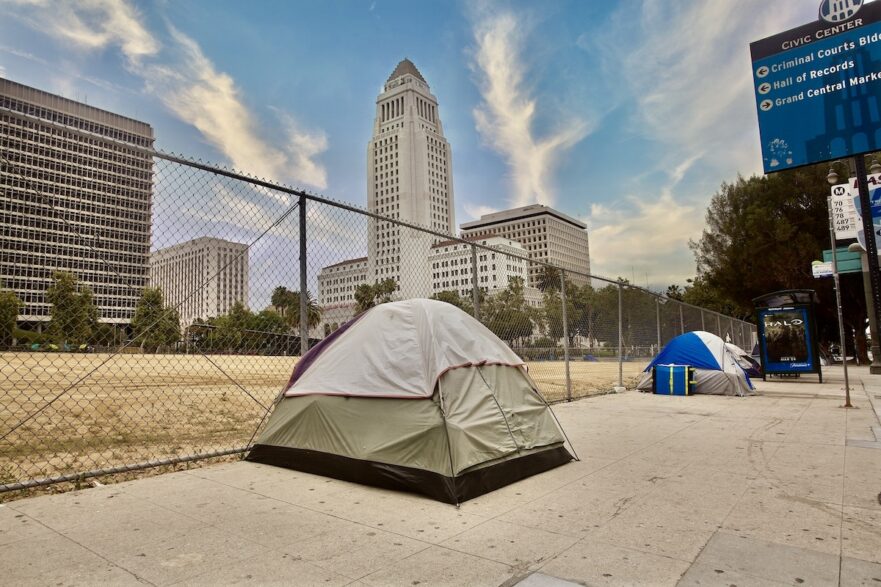
Los Angeles politicians sure don’t make it easy for nonprofits that provide permanent, low-income housing at single-room occupancy buildings in Downtown L.A.—even though the city has been mired in a catastrophic homelessness crisis for years. One would think Mayor Karen Bass and the City Council would roll out the red carpet for the organizations. Instead, city hall bureaucracy and hostility make it nearly impossible for the SRO nonprofits to operate, and the homelessness disaster is not getting any better.
Things are pretty dire in Los Angeles.
There are 45,194 unhoused residents in Los Angeles, with Mayor Karen Bass unwilling, or unable, to switch gears after it’s become distressingly clear that her top homeless program, Inside Safe, isn’t working.
The Los Angeles Times, for example, reported in April that the “longer Inside Safe exists, the greater the share of participants who have returned to ‘unsheltered.’” The paper also noted that when “Inside Safe finished its third year, about 40 percent of [the program’s] participants were back on the street.”
Months later, the L.A. Times reported that the Inside Safe team, which places homeless people in temporary housing with the final goal of putting them in permanent housing, continually went to the same neighborhoods to find unhoused Angelenos. In other words, people were not staying in housing, and they were going back to where they came.
UCLA Law School professor emeritus Gary Blasi, a highly respected expert on homelessness, told the L.A. Times that Inside Safe has become too expensive to justify the poor results and needs “a thorough re-engineering.” He pointed out that the city has been paying for individuals to live in expensive motel rooms for long periods of time, not in permanent housing.
“Once they started having people in interim housing for nine months or a year, that should have rang some alarm bells, because that’s just not sustainable,” Blasi said to the L.A. Times.
Yet Bass, whose homeless program has already cost a whopping $300 million, refuses to listen to experts like Blasi and keeps doing the same old thing.
Bass also has the power to fire department chiefs if they aren’t making the grade. Which is important. Because it’s widely known that city hall bureaucracy is a mess—affordable-housing developers and operators often deal with constant delays by city agencies to receive approvals and permits to build or update lower-income and homeless housing. Bass could change that by telling department heads to speed things up—or suffer the consequences of getting the heave-ho.
On top of all that, Los Angeles City Planning doesn’t expect to meet state goals for the construction of new affordable housing in L.A.
According to a city report, the Regional Housing Needs Allocation set a goal of 115,978 extremely-low-income and very-low-income units to be built by 2029. The planning department expects only 33,000 of those units will be constructed before 2030.
In addition, the report notes that the city will not hit state goals for low-income and moderate-income housing. But, plenty of luxury housing, which moderate- and lower-income Angelenos can’t afford, is expected to be built: 247,000 units out of a state goal of 196,831.
So things are horrible for L.A., and one would think the city would desperately want to construct new affordable housing—as soon as possible.
Bass and the City Council can do that by embracing the adaptive reuse of existing buildings, such as single-room occupancy hotels that have long provided lower-income housing in L.A. One would also think that Bass and the City Council would want to make sure that SRO nonprofits continue to operate and stay healthy financially. Guess again.
A month ago, SRO Housing Corp., the largest provider of housing for formerly homeless residents in Downtown L.A., sounded the alarm that it was running out of money and needed help from the city to keep going. The organization operates 2,500 units, so it would be in everyone’s best interest, including the public’s, to deliver funding to SRO Housing Corp. That hasn’t happened.
Anita Nelson, the CEO of SRO Housing Corp., met with city officials last spring and explained the need for money. But not much has happened since then.
“They’re not feeling our sense of urgency,” Nelson told Politico. “The sense of urgency for me is real.”
It’s happening under Mayor Karen Bass’s watch, but she’s still plowing tens of millions of dollars into Inside Safe, which only provides temporary housing.
Then there’s Skid Row Housing Trust, which operated 29 SRO hotels in Downtown L.A. and ran out of money in 2023. The organization had a number of problems, including maintaining the expensive upkeep of buildings, which has been a continual problem for SRO nonprofits—and the city doesn’t want to help.
“A few of us have been fighting for years for preservation dollars to be available through the city and the state and the tax credit program,” Dora Gallo, chief executive of A Community of Friends, told the L.A. Times. “The focus at all levels of government is new production, more housing, and there doesn’t seem to be a willingness to invest in older buildings.”
That, too, happened under Bass.
And there’s AIDS Healthcare Foundation, the parent organization of Housing Is A Human Right. AHF operates several SROs in Downtown L.A., providing permanent housing for very low-income tenants and helping people get off the streets.
But AHF has been waiting years for city approvals and permits to improve electrical power at the Barclay Hotel. As a result, the building can handle only so many tenants, leaving many units vacant. AHF also dealt with long delays to get the go-ahead from the city to carry out power upgrades at the King Edward Hotel, which resulted in power outages that impacted staff and tenants.
Again, it happened under Bass, who’s still sticking with the troubled Inside Safe program.
It all adds up to a disturbing, years-long pattern that makes one think that the city’s lack of urgency to help SRO nonprofits is a sign that Bass and the City Council actually want the organizations to fail. That way, major developers can buy SRO hotels, tear them down, and build a brand new luxury apartment high-rise, further gentrifying Downtown L.A. and forcing unhoused residents out of the area.
In other words, L.A. City Hall is hostile to SRO nonprofits because local politicians may want them gone.
That may seem far-fetched, but it’s a conclusion that’s hard to avoid, especially when you consider what Dora Gallo told the L.A. Times. In the meantime, six homeless people die on the streets in the L.A. area every day.
Patrick Range McDonald is a veteran investigative reporter and the award-winning advocacy journalist for Housing Is A Human Right.