
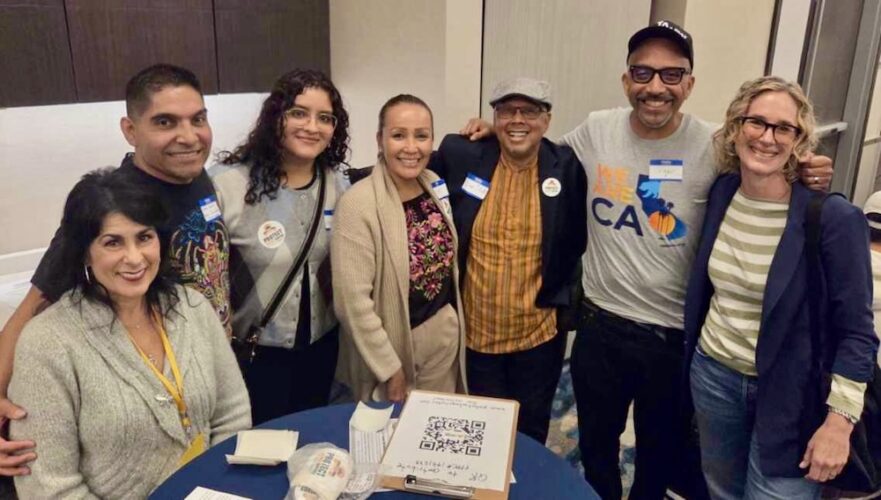
On Election Day, in Salinas, California, it was a rout: Measure H, which was bankrolled by Big Real Estate, was shot down by 25 percentage points. Voters overwhelmingly sided with activists and tenants to keep strong tenant protections, including rent stabilization. It was a resounding underdog victory, and John Silva (third from the right) was one of the activists who helped make it happen.
Silva, a retired doctor who served Salinas residents for 40 years, was a member of the fundraising and finance committee of Protect Salinas Renters, the official name of the No on Measure H campaign. The California Association of Realtors and UDR, one of the largest corporate landlords in the United States, were the opponents, trying to pass Measure H to repeal rent stabilization, a rental registry, just-cause eviction, and a tenant anti-harassment ordinance. Big Real Estate outraised Protect Salinas Renters by nearly 11 to one. With that kind of enormous fundraising gap, the real estate industry usually wins in ballot measure contests. This time, it didn’t.
A national rent control movement has been rising up the past several years in the United States, including major victories in St. Paul and Minneapolis in Minnesota in 2020. The rent-control win in Salinas, an agricultural city in Northern California with a sizable working-class population and the birthplace of The Grapes of Wrath author John Steinbeck, is just as momentous – and provides lessons for other grassroots campaigns going into battle against Big Real Estate.
Housing Is A Human Right recently talked with Silva about the election – AIDS Healthcare Foundation, the parent organization of Housing Is A Human Right, contributed to the No on Measure H campaign. He was first asked why the victory was so important for tenants and activists not only in Salinas, but also around the country.
“In California,” Silva said, “particularly these coastal counties, the price of housing doesn’t follow market rules. There is an extreme shortage of very-low and low-income housing units. In this setting, there has to be a mix of demand-side policy. That’s where rent stabilization and tenant protections fit in.”
He added, “I know there are other cities, nationwide, with a similar formula of low [affordable housing] inventory and large working-class populations.”
Silva was hitting upon a fact that the real estate industry, politicians, and YIMBY leaders rarely talk about: there’s a huge need for new moderate- and lower-income housing, and less of a need for new, expensive luxury housing.
In California, for example, state officials set a goal of 642,151 very-low-income units to be built within the next few years, but only 5.3 percent have been constructed so far. In addition, only 14.9 percent of low-income units have been built and only 10 percent of moderate-income apartments. Yet its poor and moderate- and lower-income residents who’ve been hit the hardest by the housing affordability crisis in California – and across the country.
With affordable housing not getting built, people need help now, and rent control is the only tool that quickly stabilizes skyrocketing rents and reins in the predatory business practices of Big Real Estate.
Throughout the campaign, Protect Salinas Renters carried out a dynamic social media campaign, highlighting, and giving voice to, tenants of all ages who need rent stabilization. Silva was asked about the key factors that helped No on Measure H take down the California Association of Realtors and UDR.
First, Silva said, the campaign’s “familiarity and relationship with the community, particularly the youth voters and labor unions, contributed to the volunteer push” that was needed for voter engagement, such as knocking on doors and talking with people.
He also credited a “social media campaign that was nimble and intense,” noting it was also an “affordable” way for Protect Salinas Renters to communicate with voters.
Third, Silva said the rough economic times that people and families are going through played an important role in getting voter support.
Lastly, he said that compared to the tenants, labor unions, and activists that made up Protect Salinas Renters, “there was zero trust in the Yes on H campaign. They were perceived as heartless outsiders. They had polling, but no canvassing. The instincts of our savvy working-class folks, and the compassion and altruism of our middle-class community, could read through [Big Real Estate’s] marketing.”
Which is no small thing.
In the past, corporate landlords and their powerful front group, the California Apartment Association, have spent tens of millions in campaign cash on misinformation campaigns to maintain statewide rent control restrictions in California. Since the mainstream media often don’t cover the real estate industry with a critical, investigative eye, voters can be easily tricked and confused by Big Real Estate’s TV and radio advertisements.
In terms of top obstacles the No on Measure H campaign faced, Silva said “it was a long campaign, which can be a good thing, yet it was challenging to keep the volunteer base activated.” A significant lack of funding compared to the real estate industry’s deep pockets also needed to be overcome. And, Silva said, political strategy and organization needed to be effectively sorted out.
“We missed some key opportunities and deadlines, for one reason or another,” he explained. “Ultimately, with two months left [until Election Day], we decided to spend money on a strategist.”
Major organizations, unfortunately, don’t always deliver much-needed contributions to grassroots campaigns like the one in Salinas. So Silva was asked how the funding from AIDS Healthcare Foundation helped the No on Measure H campaign.
“The first bolus of funds [from AHF], six months from Election Day, gave us confidence that we could get things off the ground with respect to fundraising,” Silva said. “The second bolus of funds helped with the last months of volunteer support and paid for some canvassing.”
As for the top takeaways from the Measure H victory, Silva explained that a “truly organized community can achieve a lot, particularly in young and working-class communities. Salinas is kind of special because of its Democratic, labor-class history.” He also found that “an effective social-media campaign is field leveling.”
And Silva believed that activists and tenants must go into a campaign full of confidence and fight.
“Don’t get intimidated by what the other side spends,” he said. “They really do not know the community, other than purchasing living spaces. They have no local presence to activate renters.”
Whether in Salinas or St. Paul, going into the community and talking with voters has increasingly become a key strategy for grassroots campaigns to defeat Big Real Estate.
Even after the big win earlier this month, Silva and other activists continue to organize tenants, hoping to create strong tenant associations or unions. The real estate industry and YIMBY groups such as California YIMBY and YIMBY Action will never stop trying to take away or oppose tenant protections, so renters and activists must be ready for the next fight.
Patrick Range McDonald is a veteran investigative reporter and the award-winning advocacy journalist for Housing Is A Human Right.